Textile history · Bedding materials
From Flock to Fill: How Naturepedic’s Wool Pillow Takes Shape
A wool pillow begins as an agricultural material and ends as something intimate: a small landscape of fiber, fabric, air and weight beneath the sleeper’s head. Following its path reveals how traditional knowledge of wool meets the engineering of contemporary bedding.
Published October 24, 2026
Before wool becomes a pillow, it belongs to a living animal, a working farm and a chain of decisions that can be difficult to see from the bedroom. The transformation is less a single manufacturing trick than a sequence: fleece is grown and shorn, cleaned and prepared, shaped into a filling, then enclosed in fabric designed to keep that filling in place. At every stage, practical questions mingle with older textile knowledge. How will the fibers move? Can air circulate? Will the fill spring back after pressure? What does the cover contribute?
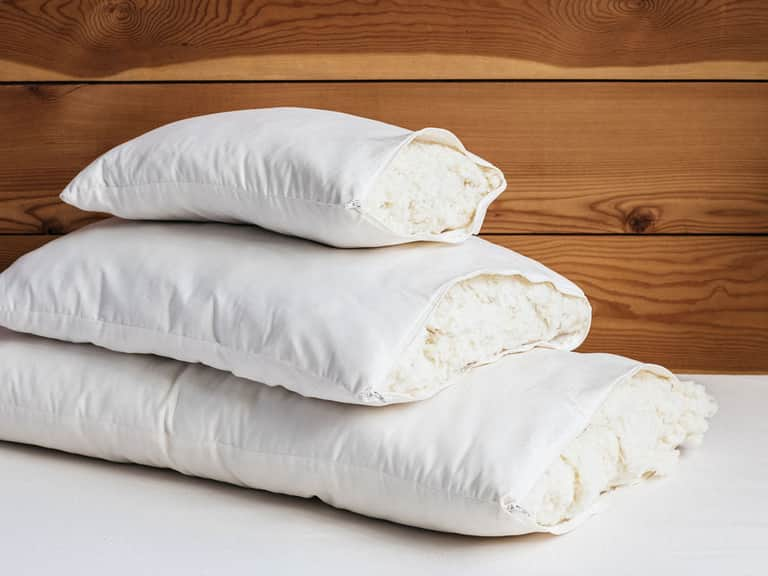
Naturepedic’s Organic Wool Pillow offers a useful case study in that relationship between material and construction. Its filling is described as small woolen balls, or “wooly bolus,” intended to encourage airflow and provide support. A GOTS-certified organic cotton cover forms the outer layer; the cover is removable and washable, while the wool insert is intended for spot cleaning. Those details are more than a list of features. They point toward a wider history of turning fleece into useful, durable household textiles—and toward the choices that distinguish one modern pillow from another.
A textile begins on the animal
Wool is not a manufactured filament with a uniform diameter and identical behavior in every direction. It is an animal fiber, grown in a fleece and shaped by breed, climate, nutrition and husbandry. A single fleece can contain fibers that vary in length, fineness, crimp and strength. Those differences matter to textile makers because they influence how wool feels, how readily it can be spun or felted, and how it performs when used as a loose filling.
The first major step in the material journey is shearing: removing the fleece, typically in one piece, so it can be sorted and processed. Shearing is an agricultural practice as well as a textile one. It requires skill and attention to the animal, and its timing and methods vary across regions and production systems. Once removed, fleece is commonly graded or sorted. Coarser and finer fibers may be separated according to their intended uses; heavily soiled portions may be treated differently from cleaner sections.
For a bedding material, the questions are direct but consequential. Is the wool clean enough for its intended use? How has it been washed and prepared? What is known about its source and the conditions under which it was obtained? A product description can provide some answers, but it rarely tells the whole story of a supply chain. Responsible reading means distinguishing a specific claim—such as a stated sourcing standard—from broad language about naturalness or sustainability.
From fleece to usable fiber
Freshly shorn wool does not arrive ready to be tucked into a pillow. It can carry lanolin, dust, plant matter and other residues picked up in the field. Scouring, the washing process used to remove much of this material, is one of the key stages between fleece and fiber. The precise method depends on the processor and the desired end use. After washing and drying, wool may be opened, separated and carded.
Carding is the preparation of fibers into a more orderly, workable mass. In traditional textile production, hand cards or a drum carder help disentangle fibers and align them sufficiently for spinning or other uses. Industrial carding performs related work at a larger scale. It does not make every fiber identical; rather, it helps create a more consistent web or batt from naturally variable material. That preparation connects a pillow’s soft, apparently simple interior to a long lineage of textile craft.
For spun yarn, fibers are drafted and twisted into a continuous strand. Pillow filling does not necessarily take that route. Batting, loose fiber clusters or other forms can be used instead, depending on the design. In the Naturepedic example, the stated “wooly bolus” construction uses small wool balls rather than presenting the fill as a single flat layer of batting. The difference affects how the contents can settle and move inside the casing, and it helps explain why filling format belongs in any serious discussion of pillow feel.
Why wool’s structure matters
Wool’s reputation for warmth is familiar, but warmth is only part of its material character. The fiber’s natural crimp gives it a spring-like structure: it can compress under load and recover to some degree when that load is removed. At the scale of a pillow, the combined behavior of many fibers creates loft and cushioning. The exact result depends on the fiber, preparation, amount of fill, casing and construction—not on the word “wool” alone.
Wool also interacts with moisture and air in ways that make it an appealing bedding fiber. It can absorb water vapor into the fiber while still feeling comparatively dry at the surface, and a loosely arranged filling can leave room for air to move. These properties help explain the common description of wool as breathable and temperature-regulating. They should not be treated as a promise that every sleeper will feel cool or that a wool pillow will solve overheating. Room temperature, bedding layers, sleep habits and individual physiology all play a part.
The older textile knowledge here is practical rather than mystical. People who have worked with wool for generations have learned that fiber structure, cleanliness, density and construction shape performance. Modern bedding adapts those lessons to a different object: one expected to support the head and neck, retain its form through repeated use and fit into contemporary laundry routines.
Wooly bolus: small clusters, considered construction
“Bolus” is a useful word to pause over. In a pillow context, wooly bolus refers to small, rounded clusters of wool used as filling. Compared with a single compact sheet of batting, loose clusters can distribute around the head and may allow the interior to be arranged in a way that feels more responsive. Naturepedic describes its wooly bolus as designed to enhance natural airflow and support, while the wool’s resilience is intended to help the pillow resist clumping and flattening.
The form of the fill matters because a pillow is not simply a container for a material. It is a system. A tightly packed pillow may feel firm and resist movement; a more open fill may feel softer or more adjustable, though those impressions depend on the quantity of wool and the dimensions of the casing. The cover must restrain the filling without making the pillow feel rigid. Stitching and internal construction can influence whether the contents stay evenly distributed or migrate toward the edges.
That is where the contemporary object meets the long craft history of textile assembly. A pillow’s casing is a woven boundary: strong enough to contain the contents, comfortable enough against the skin when covered, and structured to hold its shape. The finished result reflects choices at two scales—the character of individual fibers and the geometry of the object that contains them.
The cotton casing has a job of its own
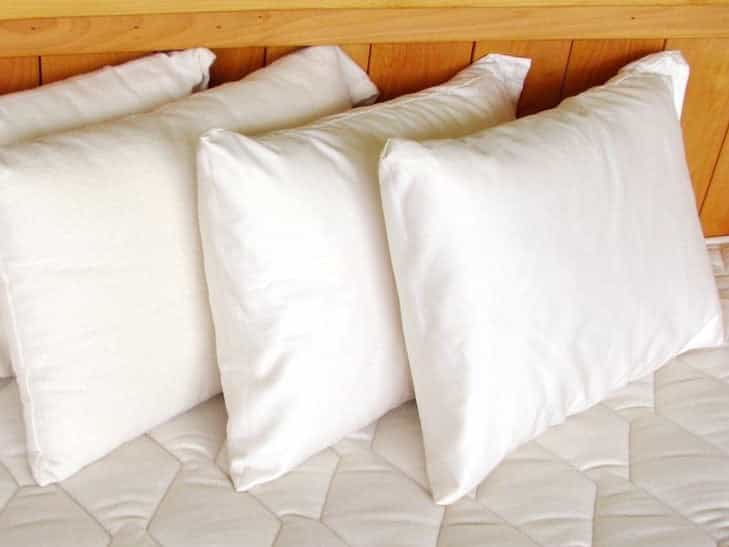
Naturepedic’s pillow is described as having a GOTS-certified organic cotton cover. Cotton and wool perform different roles. The wool provides the filling; the cotton forms the textile envelope around it. A breathable, durable casing can help protect the fill from routine contact while giving the pillow a smooth surface beneath a pillowcase. A removable outer cover also makes cleaning more practical: the layer most directly exposed to skin and household dust can be laundered without treating the wool insert as if it were ordinary machine-washable fabric.
GOTS—the Global Organic Textile Standard—is a textile certification framework that addresses organic fibers and environmental and social criteria across specified stages of processing. A certification claim is most useful when readers understand what it applies to. In this case, the product description identifies the cotton cover as GOTS-certified; that does not automatically mean that every component, facility or step in the pillow’s full supply chain is covered by the same certification. Certification can offer meaningful verification, but it is not a substitute for reading the scope of a claim.
Nor does “organic” mean impact-free. Farming, washing, spinning or carding, weaving, transportation and assembly all use resources. The term describes standards or practices within a defined system; it does not erase the environmental footprint of production. Clear sourcing information is valuable precisely because it lets consumers ask better questions, rather than treating a label as an all-purpose answer.
What the finished pillow tells us
The finished Naturepedic Organic Wool Pillow brings those choices together: wooly bolus fill, an organic cotton cover, a construction intended to support airflow and resilient loft, and a removable outer layer that can be washed. Its product information lists standard, queen and king dimensions, and recommends using a pillow protector. The insert itself is spot-clean only, while the outer casing can be removed, machine-washed in cold water and dried before reassembly.
That division of care reflects a broader truth about natural fillings. The fact that a fiber comes from nature does not mean it should be washed casually or treated as indestructible. Water, heat, agitation and incomplete drying can alter a wool filling. Following the manufacturer’s instructions protects both material and construction. A separate washable cover or protector helps reduce how often the inner fill needs attention, while airing the bedding can be a simple routine between washes.
Care is also part of a product’s environmental story. A pillow that is protected and maintained may remain useful longer; extending its working life can matter as much as choosing a material with appealing credentials. Durability, repairability, replacement options and end-of-life handling are all part of a more complete account of sustainability. For a mixed-material object, the route to recycling or composting may not be straightforward, so longevity deserves attention from the beginning.
A useful example, not a universal answer
Wool pillows are not identical, and natural fibers do not guarantee a particular sleep experience. Some designs use wool batting; others use wool clusters, removable puffs or wool wrapped around a firmer core. Fill can be adjustable or fixed. Covers may be removable, stitched in place or designed as separate protectors. Each construction changes the way the pillow feels and the amount of maintenance it requires.
For shoppers and textile enthusiasts alike, a careful comparison begins with questions rather than adjectives. What is the filling’s form? Can loft be adjusted? Which components are washable, and how? What certification applies to which material? Is the wool’s origin described? Does the maker explain how the pillow is assembled and what is covered by a warranty? Such questions turn an abstract interest in “natural bedding” into an understanding of a specific object.
Naturepedic’s pillow is a particularly clear illustration because its described construction puts the material story in view. The wool is not merely named; its small cluster form is identified. The cotton casing is not merely called natural; its certification and care are specified. The product becomes legible as a collection of linked decisions, from the preparation of the fiber to the maintenance routine in the home.
The long life of a simple idea
People have used wool for clothing, blankets and household textiles for centuries because it is available, workable and adaptable. The modern pillow changes the setting, not the underlying material logic. A fleece is transformed through careful preparation; a textile structure contains and organizes it; the finished object is judged through daily use. The passage from flock to fill is therefore both industrial and intimate—a meeting of agricultural practice, textile skill and the ordinary need for rest.
To look closely at a wool pillow is to see more than a soft object. It is to see how a fiber’s crimp can become loft, how loose clusters can make a filling, how cotton can form a protective boundary, and how care instructions preserve the whole. It is also to recognize the limits of what a product description can tell us. Material claims are a beginning, inviting further questions about sourcing, processing and the standards behind each label.
Naturepedic’s Organic Wool Pillow can be explored as a contemporary example of that continuity: view the Naturepedic Organic Wool Pillow. Its design draws on the familiar qualities of wool while translating them into a carefully specified bedding construction. The result is not simply wool placed inside a case. It is the final chapter—at least until the pillow is cared for, used and eventually replaced—in a story that begins with a fleece.
A short glossary
- Fleece: The wool coat shorn from a sheep.
- Scouring: Washing raw wool to remove much of its grease, soil and other residues.
- Carding: Separating and arranging fibers into a more workable web or batt.
- Batting: A layer or sheet of prepared fiber used as padding or filling.
- Wooly bolus: Small clusters of wool used as a pillow filling.
- GOTS: The Global Organic Textile Standard, a certification framework for organic textiles with defined environmental and social criteria.