Materials, craft, and everyday use
Sleep and Beyond’s Portable Bedding: Materials, Making, and Care
A compact pillow is a small object with a practical purpose: bringing a familiar measure of comfort into unfamiliar places. Its usefulness depends not only on size, but on the materials inside, the way they are assembled, and whether their care requirements suit life on the move.
Published November 9, 2026
Travel bedding sits at the intersection of domestic routine and movement. A pillow that lives at home can be large, carefully arranged, and rarely expected to leave the bedroom. A portable version has a different brief. It must be small enough to pack, comfortable enough to use in a new setting, and straightforward enough to maintain without turning every journey into a laundry project.
That brief makes natural-fiber bedding worth examining closely. Wool and cotton have long been used in household textiles, but their behavior depends on how they are prepared and combined. A pillow filled with wool batting is not quite the same object as one filled with loose wool clusters; a washable cotton case does not make the wool inside machine washable. The details determine how a piece feels, travels, and ages.
Sleep and Beyond is associated with wool bedding, including pillows and other sleep products. When considering any compact bedding style under that name, it helps to separate the broad appeal of wool from the particulars of an individual design. Fill, shell fabric, dimensions, construction, and care instructions should be checked for the specific item rather than assumed from a material label or brand association.
Why portable bedding has a different job
A travel pillow is not simply a standard pillow made smaller. Scale changes the experience. A compact pillow offers less surface area and usually less fill, so its shape and density matter. It may be used in a guest room, at a family visit, in a vehicle, or as a familiar comfort object away from home. For children, a small pillow can be easier to carry and easier to place in a sleeping space than a full-size bed pillow.
Portability also changes the way care should be considered. At home, bedding may have a dedicated storage place and access to a full laundry setup. Away from home, a removable case can be more useful than a pillow that must be washed as a whole. A compact piece that is spot-clean only may travel well but still require protection from spills, dampness, and prolonged compression in a bag.
That is why the simplest useful comparison begins with questions rather than slogans. What is the fill? Is it loose, layered, or formed into clusters? Can the fill be removed? Is there a separate case? Which parts can be washed, and how must they dry? The answers describe how the pillow will fit into real routines better than a general claim about comfort.
Wool: resilient, breathable, and particular about care
Wool is a natural animal fiber with a long history in clothing, blankets, and household textiles. In bedding, its structure helps create a cushion of air within the filling. Wool can absorb moisture vapor and release it gradually, while its crimped fibers contribute loft and a springy hand. These characteristics are often valued in bedding intended for use across changing seasons.
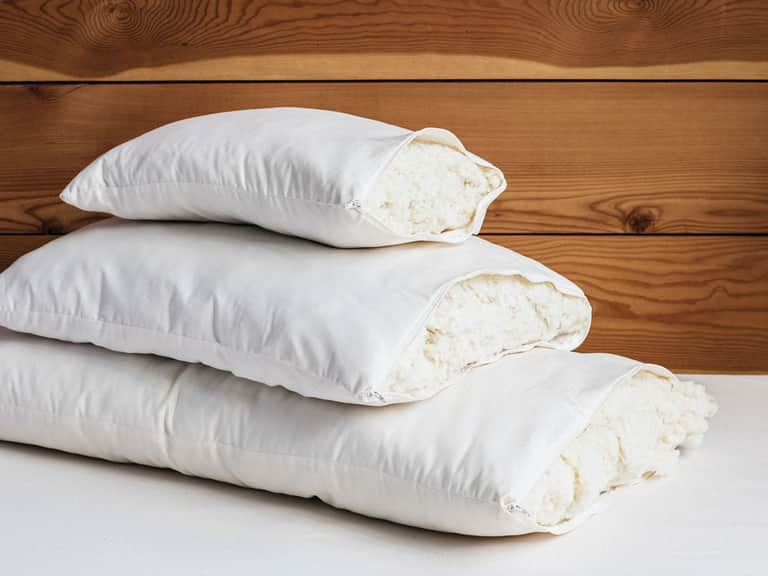
Those qualities do not mean every wool pillow feels the same. The fiber’s breed, processing, length, cleanliness, and arrangement all influence the result. Wool batting is a sheet-like layer of fibers, while wool clusters or “bolus” are small, formed pieces that can move more independently inside a pillow. Clustered fill may be easier to redistribute or adjust, while batting tends to create a more continuous, even structure. Neither construction is automatically better; the choice depends on the desired feel and the maker’s design.
Wool also asks for measured care. Some wool-filled pillows are spot-clean only, and the fill should not be immersed or put into a washing machine. Water, agitation, and heat can encourage felting or distortion. Other products use specially processed, washable wool, but that is a product-specific feature—not a rule that applies to wool bedding generally. The care label is the authority.
Airing is often a useful maintenance habit. In a dry, well-ventilated place, fresh air can help bedding feel refreshed between uses. Gentle airing is different from leaving a pillow for hours in harsh direct sunlight or near a heater, which may be unsuitable for a particular cover or filling. If the manufacturer recommends occasional sunning, follow that guidance with attention to the fabric, temperature, and duration.
Cotton covers and the value of a separate case
Cotton is a familiar partner for wool because it can be woven into a soft, breathable shell. Percale and sateen are different weave structures, not different fibers: percale commonly has a crisp, matte feel, while sateen tends to have a smoother surface and subtle sheen. Thread count alone does not settle questions of quality or suitability. Weave, yarn, finishing, and the way fabric is maintained all contribute to how a cover feels.
For a travel-size pillow, a separate case can be especially practical. It provides a removable layer between the pillow and the sleeper, and it can be washed more often than a delicate or non-washable fill. A spare case also gives a traveler a clean surface after a pillow has been packed and unpacked. The important distinction is between the case and the pillow itself: a washable case does not mean the inner pillow can be washed.
When evaluating a portable wool pillow, look for clear information about each layer. A description should identify the shell material, the type of wool fill, whether a separate case is included, and the care method for each component. If the information is incomplete, it is sensible to ask before washing or attempting to adjust the fill.
From fiber to finished pillow
The making of a wool pillow begins well before its cover is sewn. Raw fleece is sorted and cleaned, then prepared through processes such as carding, which separates and aligns fibers into a more usable form. For batting, carded fibers are formed into layers. For cluster fill, wool may be shaped into small tufts or puffs. Construction choices affect how the filling settles, how evenly it supports the head, and whether it can be reshaped after use.
The shell must hold the filling securely while remaining comfortable against the face. A zipper can make a pillow adjustable or allow its cover to be removed, but the presence of a zipper does not by itself indicate that the product is designed for frequent adjustment. A sewn, quilted, or layered structure may instead prioritize a stable shape. Details such as seam strength, closure placement, and the quality of the inner casing become more significant when the pillow is repeatedly packed and handled.
For a compact design, dimensions and fill weight offer clues to what the object is intended to do. A small pillow can be convenient for travel, but it may not reproduce the height or support of a full-size bed pillow. It may be best understood as a familiar, portable cushion rather than a universal substitute for every sleeper’s regular pillow. Comfort remains personal, and neck support depends on body shape, sleeping position, mattress surface, and preference.
Portable wool bedding in context
Examples from the wider natural-bedding market illustrate how varied the category can be. A compact wool pillow might use loosely filled clusters, layered batting, or another construction altogether. Some designs are intended for travel; others are small snuggle pillows made for children and everyday use. Those distinctions matter because similar dimensions or materials do not necessarily indicate the same purpose, manufacturer, or care routine.
For instance, a separate compact product listed as the Certified Organic Snuggle Pillow is described as a 12.5-by-17.5-inch pillow with GOTS-certified organic wool fill and an organic cotton sateen shell, plus a separate case. Its instructions call for periodic airing and spot cleaning of the pillow, while the separate case can be machine washed in cold water and line dried or tumble dried on low. It is identified as a Holy Lamb Organics product, not a Sleep and Beyond product. The distinction is useful: an example can clarify how portable wool bedding is constructed without implying that products from different makers are interchangeable.
Sleep and Beyond’s wool bedding, by contrast, should be assessed through the specifications supplied for each of its individual products. A full-size washable wool pillow, an adjustable wool pillow, and a travel-size item—if offered—could differ in fill, shell, size, and cleaning instructions. Brand-level descriptions provide context, but they do not replace a product’s own label or care guide.
A practical comparison checklist
Before choosing portable comfort for a trip or a second sleeping space, make a short comparison using the points below. This keeps attention on function and maintenance rather than treating “natural,” “organic,” or “travel” as complete descriptions.
- Fill: Identify whether the pillow contains wool batting, wool clusters, or a blend. Check whether the fill is adjustable and whether adjustment is meant to be done at home.
- Cover: Confirm the fiber and weave of the shell, and whether a separate removable case is included.
- Size and weight: Compare measurements and fill weight with the intended use. A compact pillow designed for portability may feel different from a standard bed pillow.
- Care: Find separate instructions for the pillow, inner fill, outer shell, and additional case. Never infer washability from a natural-fiber label.
- Certification: If organic certification is important, check which component is certified and what the certification applies to. Avoid assuming that certification of one material covers every part of the item.
- Origin and sourcing: Look for specific information about where fibers were sourced and where textile processing or sewing took place, while recognizing that a product may involve several countries.
- Purpose: Decide whether the pillow is intended for travel, children, guest use, or everyday bed use. One shape may not serve all of those purposes equally well.
How to care for a wool travel pillow
Routine care begins with prevention. Use the included case, if there is one, or a correctly sized washable pillowcase. Keep the pillow dry during travel and avoid storing it for long periods while compressed in a tightly packed bag. When returning home, unpack it and allow it to breathe before putting it away. These small steps can reduce the need for more intensive cleaning.
For routine refreshing, follow the maker’s directions on airing or sunning. If the pillow is spot-clean only, address a small mark promptly with a lightly damp cloth and an appropriate gentle method, taking care not to soak the filling. Test any cleaning method cautiously on an inconspicuous area of the cover where possible, and allow the pillow to dry completely in a well-ventilated place before using or storing it.
Wash a removable cover only as directed. Cold water, a gentle cycle, and low-heat or line drying are common instructions for cotton cases, but product labels differ. A pillow with adjustable wool clusters may require the fill to be removed before the case is washed; the clusters themselves may not be washable. Keep the filling dry and away from lint, pets, and open windows while the case is off.
Storage is part of care, too. A clean, dry cupboard or breathable storage bag is generally preferable to a damp or airtight space. If a pillow develops a persistent odor, visible mold, or a stain that cannot be safely addressed at home, consult the manufacturer’s instructions rather than applying strong cleaners or high heat. Careful treatment can help preserve a natural filling, but no pillow is maintenance-free.
The broader meaning of a small textile
Portable bedding offers a modest example of how textile traditions adapt to daily life. Wool’s history is often told through garments, blankets, and woven cloth; in a compact pillow, the fiber is reshaped for a quieter task. Cotton becomes a casing and a removable boundary. Carding, stitching, and finishing—processes that can seem technical—ultimately determine whether a small object is pleasant to use and practical to maintain.
That perspective also encourages a more careful idea of sustainability. A natural fiber is not automatically sustainable in every context. Responsible judgment depends on sourcing, animal welfare, processing, durability, transport, and the likelihood that the item will be used for a long time. Clear claims and traceable standards can help readers evaluate those questions, but they should be read precisely: a certification applies to defined materials or processes, not necessarily to every stage of a product’s life.
There is a cultural dimension to the care itself. Airing, repairing, protecting, and washing only what needs washing are familiar habits in the history of household textiles. They recognize that an object’s useful life depends partly on how it is treated. A travel pillow may be small, but it carries the same questions as a larger blanket: where its fibers came from, how they were worked, and what care helps them last.
A more informed choice
The best portable bedding is not necessarily the lightest, softest, or most heavily certified option. It is the one whose construction suits its purpose and whose care requirements fit the person who will use it. Wool can provide a resilient, breathable fill; cotton can offer a familiar, washable surface. But the precise combination—batting or clusters, sewn or adjustable, spot-clean only or washable—makes the practical difference.
For Sleep and Beyond products, as for any natural-fiber bedding, the sound approach is to read the individual specifications and care label rather than extrapolate from the brand or material. Check dimensions, filling, cover fabric, certifications, and cleaning directions. With those details in hand, a compact pillow becomes easier to judge—not as a promise of perfect sleep away from home, but as a thoughtfully made textile designed to bring a little continuity into unfamiliar surroundings.